Death's inevitability
The Stranger (Albert Camus Edition)Mortality is the governing certainty of Meursault’s world. It first appears as an uncertain fact—the telegram reports that his mother has died, but he cannot tell whether the death occurred today or yesterday—and develops into the unavoidable condition that levels social judgment, personal choice, religious consolation, and legal punishment. By the end, mortality is no longer merely the sentence awaiting him; it becomes the basis on which he recognizes a shared fate and accepts the universe’s indifference.
Death Enters Through Ordinary Speech
The first encounter with mortality is stripped of ceremony. The telegram from The Home for Aged Persons states that Meursault’s mother has died and that the funeral will take place the next day, yet the exact date remains doubtful. Meursault arranges two days’ leave from his employer and plans to travel by bus to Marengo, keep the customary vigil beside the body, and return to Algiers. His practical schedule places death beside transportation, employment, and return time, making the event appear at once momentous and administratively ordinary.
The death also becomes a social expectation before it becomes an inward realization. Meursault imagines that the funeral will give the fact an official seal and make his mother’s death real to him. He worries that his employer may think his absence inconvenient and apologizes even though he has no reason to excuse himself. Later, Raymond Sintès treats death as something that was bound to happen sooner or later when he tries to comfort Meursault. The remark acknowledges mortality as universal, but its casualness also shows how ordinary language can flatten the singularity of a person’s death.
Mortality as the Measure of Judgment
During the investigation, the magistrate asks Meursault whether he regrets what he has done. Meursault distinguishes regret from vexation: his response does not offer the emotional language expected by the court. The question therefore links mortality to moral interpretation. What matters to the authorities is not only that a man has died, but whether the accused performs the approved response to death and demonstrates the feelings society considers appropriate.
The same demand returns in the magistrate’s judgment of Meursault’s character. The magistrate is disturbed that Meursault does not respond to the Crucifix as other criminals have responded, and he calls him hardened. Meursault realizes that he is being treated as a criminal, yet he cannot reconcile himself to the category. His silence and emotional flatness become evidence against him, so mortality is made into a test of social conformity: the dead person’s status and the accused man’s behavior at his mother’s funeral are treated as signs of moral worth.
The Prisoner’s Arithmetic of Time
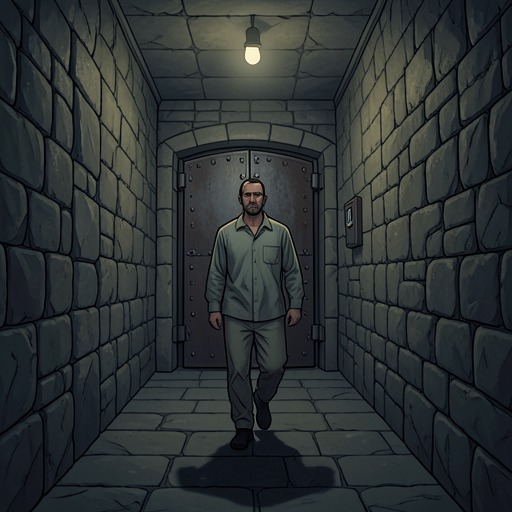
In prison, mortality changes from a fact at the edge of experience into a daily calculation. Meursault studies the possibility of escaping the implacable machinery of justice and imagines a last-minute flight before the Guillotine falls. He longs for even a remote instance in which chance might interrupt the sequence leading from verdict to execution. A reckless dash, a bullet in the back, or any brief opening toward freedom would offer more hope than the certainty of being trapped.
He finds the legal sentence philosophically disproportionate to the event that follows it. The verdict might have been delivered at five in the afternoon rather than eight; it might have been different; it was pronounced by men who change their clothes and attributed to the vague collective authority of the French people. These contingencies seem to weaken the decision’s abstract gravity. Yet once the verdict has been pronounced, its effects become solid and tangible, as real as the prison wall against which he lies. Mortality thus exposes the gap between human procedures and the physical certainty they impose.
Meursault repeatedly disciplines himself by assuming the worst: his appeal has failed, and he will die. He reasons that life is not worth living in any case and that the difference between dying at thirty and dying at seventy is small because the world will continue after either death. The argument does not fully console him, since the years he might have lived remain painfully imaginable. He then imagines being old and already cornered by death, where the exact manner of dying would matter little. Only after establishing this grim alternative does he permit himself to consider a successful appeal, and the sudden joy that follows must itself be controlled. Mortality produces a rhythm of despair, calculation, hope, and renewed restraint.
Waiting for the Dawn
The routine of execution gives mortality a physical schedule. Meursault knows that condemned prisoners are taken at dawn, so his nights become periods of waiting for the first light. He sleeps intermittently during the day and listens through the darkness for the hour when footsteps might approach. The faintest sound sends him to the door, where he presses his ear against the cold wood and hears his own rapid breathing. Each morning without footsteps grants another twenty-four hours, turning survival into a temporary reprieve rather than a secure possession.
The prison also makes mortality return through memory and recurrence. While looking at his solemn reflection in a polished tin pannikin, Meursault hears his own voice and understands that he has been speaking to himself. A remark made by the nurse at his mother’s funeral comes back to him: there is no way out. The remembered sentence connects the funeral, imprisonment, and execution into one structure. Death is not confined to the moment of bodily ending; it haunts the spaces between events, returning through repeated thoughts, waiting, and silence.
Dispute with Religious Consolation
The chaplain offers a universal version of mortality. He tells Meursault that every person on earth is under sentence of death and argues that dying later does not remove the same final question. Meursault rejects this as consolation because the condemned prisoner’s immediate sentence is not equivalent to ordinary knowledge of eventual death. The chaplain’s abstraction diminishes the difference between an uncertain future and an execution that may come at dawn.
Meursault answers that he will face the final hour exactly as he is facing the present one. When the chaplain insists on hope and asks whether death means complete extinction, the conversation becomes a conflict between religious continuity and material certainty. Meursault finally seizes the chaplain by the cassock and erupts in anger, rejecting prayers and the certainties behind them. He declares that he is sure of his present life and of the death approaching him; this certainty is limited, but it is something tangible, unlike promises about what may remain after death.
Recognition and Shared Fate
The outburst clarifies Meursault’s deepest conclusion. He looks back over his life and sees that he acted as he did, could have acted differently, and did not choose those alternatives. Yet all those possibilities have been carried toward the same present moment and the coming dawn. From the horizon of his future, a persistent wind has leveled the values others tried to impose on him: the deaths of other people, a mother’s love, God, and the belief that a person freely chooses a destiny that is ultimately unique.
Mortality also erases the distinctions on which social judgment depends. Every living person belongs to the same condemned class, including the chaplain, Raymond Sintès, Céleste, Marie Cardona, Salamano, and Salamano’s dog. The comparison is deliberately unsettling: the court may distinguish guilt, respectability, friendship, and emotional propriety, but death finally reaches everyone. Meursault’s mother, the old people at The Home for Aged Persons, the murdered man, and the people who will judge him all occupy different social positions while sharing the same terminal condition.
This recognition changes the meaning of his mother’s final years. Meursault imagines that, with death near, she may have felt like someone on the brink of freedom, ready to begin again. The possibility of a new attachment and a fresh start in the Home no longer seems absurd or disloyal. Mortality has made her late-life renewal intelligible to him: when the end is close, beginning again can become a form of freedom rather than a denial of death.
Acceptance Without Consolation
After the confrontation with the chaplain, Meursault falls asleep and wakes beneath the stars, hearing the countryside and a steamer’s siren as people depart toward a world that no longer concerns him. The calm summer night follows the violence of his anger and gives the conclusion a changed emotional register. His anger has emptied him of hope, but it has also freed him from the need to pretend that death can be defeated by religious assurance or social explanation.
Meursault finally opens himself to the benign indifference of the universe. He feels that indifference as something akin to himself and even brotherly, not because mortality has become meaningful in a conventional religious sense, but because the universe imposes no false promise of exemption. He understands himself as having been happy and as remaining happy. His last wish is not escape from death but a public encounter with it: he wants a huge crowd at his execution, greeting him with cries of hatred. Mortality therefore ends not in consolation, redemption, or reconciliation with society, but in a lucid acceptance of shared finitude and the strange freedom that comes from refusing to disguise it.